Getting Started
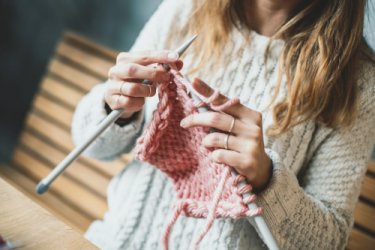
So you're ready to learn to knit? Fantastic! Let's talk about these topics before running out and buying supplies:
- Your recipient?
Who are you making your items for? Is it for you? Someone else? Maybe there's a baby on the way and you want to make a gift?
- What will you make?
Since you are just learning to knit, diving into blankets and more time-consuming projects might not be feasible, unless you plan out when the project needs to be done and dedicate some time to it. Your best bet is to practice first, then working up to a real project. It will be a little frustrating at first as you develop memory muscles in your hands for knitting, but the results are so rewarding!
- The Yarn
So, you've chosen who your recipient is, and what you are going to make them. Choosing your yarn weight is important. You don't want to buy a fingering yarn for a baby blanket - it takes too long to work through (although I commend you if you want to!), and you don't want to buy an aran weight (too heavy) for a baby born in the summer.
Yarn weights are as follows (from lightest to heaviest): Lace (0), Fingering/Sock (1), Sport (2), DK (3), Worsted/Aran (4), Bulky (5), Super Bulky (6), and jumbo (7). You'll see the numbers in parenthesis on some manufacturer labels. The numbers indicate the weight without description. In most commercial craft stores, you'll see the 4 the most (Worsted/Aran weight), because that is the most widely used yarn by crafters. Most speciality yarn stores will carry all the weights of yarn, from lace to jumbo, and will be glad to help you pick out yarn for your project.
- The Needles
You've picked out yarn! Hooray! Now you need the needles to go with it. Again, there are range of needle sizes, just like there are a range of yarn sizes. The sizes in the U.S. go from 000 - 70. That's a lot, but we're going to break it down into bite-size pieces for you.
U.S. Knitting Needle Sizes: (click on the triangles for more information!)
These needles work with lace weight yarn.
| U.S. Size Range | Millimeter Range |
|---|---|
| 000 | 1.50 mm |
| 00 | 1.75 mm |
| 0 | 2.00 mm |
| 1 | 2.25 mm |
These needles work with fingering/sock weight yarn.
U.S. Size Range
Millimeter Range
1
2.25 mm
2
2.75 mm
3
3.125-3.25 mm
These needles work with sport weight yarn.
U.S. Size Range
Millimeter Range
3
3.125-3.25 mm
4
3.50 mm
5
3.75 mm
These needles work with DK weight yarn.
U.S. Size Range
Millimeter Range
5
3.75 mm
6
4.00-4.25 mm
7
4.50 mm
These needles work with worsted weight yarn.
U.S. Size Range
Millimeter Range
7
4.50 mm
8
5.00 mm
9
5.25-5.50 mm
These needles work with bulky weight yarn.
U.S. Size Range
Millimeter Range
9
5.25-5.50 mm
10
5.75-6.00 mm
10 ½
6.50 mm
11
8 mm
These needles work with super bulky weight yarn.
U.S. Size Range
Millimeter Range
11
8 mm
13
9 mm
15
10 mm
17
12.50-12.75 mm
These needles work with jumbo weight yarn.
U.S. Size Range
Millimeter Range
17
12.50-12.75 mm
19
15 mm
35
19 mm
50
25 mm
70
35 mm
You'll notice that the needles sizes overlap, and that is because yarns that fall close to the former or latter weight class can also use that size needle. The other reason is your tension, which we'll talk about next.
- Your Tension
You've picked your yarn, you've got the needles you think will work with the yarn, so you can start knitting. One of three things is going to happen:
- This yarn is too tight!
If you are fighting the yarn to come off the needle, your cast-on, and subsequent knitting might be too tight, and you may have to go up 1-2 needle sizes.
- This yarn is too loose!
If your yarn is just falling off the needle and you have giant pockets of air between your rows, your cast-on and subsequent knitting is much too loose and you might have to go down 1-2 needle sizes.
- This yarn is just right!
If your yarn is not too loose on the needles, and it slides easily when you push it with your fingers, and you're not fighting to get it off the needles, there's a good chance you have the right size needles for your yarn.
What this all equates to is "your tension". How tight you cast-on, and how tightly (or loosley) you knit depends on your individual tension in your hands. If you have the weight yarn you like, it's simply a matter of going up or down needles sizes to see what works for the yarn you're using. It is also always best to have a variety of needles on hand for this reason!
For example: You have a worsted weight yarn, which calls for a size 7 - 9 needle. If your knitting is too loose on size 9, you should go down one or two needle sizes (try 8, and if it's still too loose, go to a 7). If your knitting is too tight, you might want to go up one needle size at a time until you're satisfied it's just right. This can also apply soley to cast-ons as well as the entire project! I have a tight cast-on for smaller needle projects, so I go up a needle size to loosen the cast-on, then change go back to the needle size they recommended for the project and continue knitting.
Everyone is different. Sometimes you'll get it right the first time, sometimes it takes a few tries and some patience.
- Gauge:
The last thing I want discuss is gauge. This is, again, up to the individual. For most fitted projects (hats, skirts, tops, sweaters etc.), you're going to need to knit a swatch of yarn and see if your gauge matches up to the one the pattern designer recommends in a project, otherwise, your entire project is going to come out too small or too big. The project will tell you what your gauge should be for the project, in each of the sizes they give.
I personally do NOT knit a swatch of yarn for baby blankets, and shawls, and cowls, where gauge, (unless it's going to come out too small/enormous otherwise), isn't really a huge facor. After a few years of knitting, you get an idea of what your gauge will be on a certain needle size with a specific yarn. Keep in mind that if you don't swatch, and you run out of yarn before the project is done, you may have to buy more, or rip your project all out and start over with a smaller needle, which will give you some padding to get the project done. It is always recommended to buy more yarn than you need just in case this happens!